CIO / VP of IT
A modernization decision you can defend to the board, predictable costs, and a single accountable team from architecture through operations.
A compute refresh now comes with licensing, consolidation and platform choices attached. ModernOps measures the estate you have and models the estate the workloads require, then sources, builds, migrates and documents the result.
A modernization decision you can defend to the board, predictable costs, and a single accountable team from architecture through operations.
A resilient target architecture and a controlled migration path for hosts, hypervisors, HCI and everything they touch.
Platform depth across VMware, Nutanix, Proxmox VE and Hyper-V, with compatibility validation, runbooks and a clean handoff.
Ticket-driven changes, documented failover behavior, backup alignment and monitored health after go-live.
Per-core hypervisor licensing now rivals the hardware cost on small clusters. A server refresh that skips the licensing recalculation is how a three-host shop ends up paying enterprise rates.
In the estates we have assessed, cluster CPU utilization has ranged from roughly 4 to 32 percent. One multi-site estate averaged about 7 percent CPU and 35 percent memory. That headroom is budget, and consolidation is usually what pays for the modernization.
Right-size the VMware renewal, migrate to Proxmox VE or Hyper-V, adopt Nutanix HCI, or stop owning compute. Each option has its own five-year cost curve, and we model all four because we sell all four.
Modern EPYC and Xeon cores consolidate five-year-old hosts at two to one or better, which cuts the hardware bill and the core count it drags behind it.
Subscription structuring, multi-year billing and core-count discipline for teams staying on VMware, plus in-place vSphere upgrades sequenced against hardware interoperability matrices with runbooks, rollback plans and post-change validation. One assessment modeled a 33 percent reduction in licensed cores, from roughly 864 to 576, while keeping CPU under 50 percent with N+1 intact. VMware remains a large part of our resale business, and we still tell customers when a renewal deserves a competing bid.
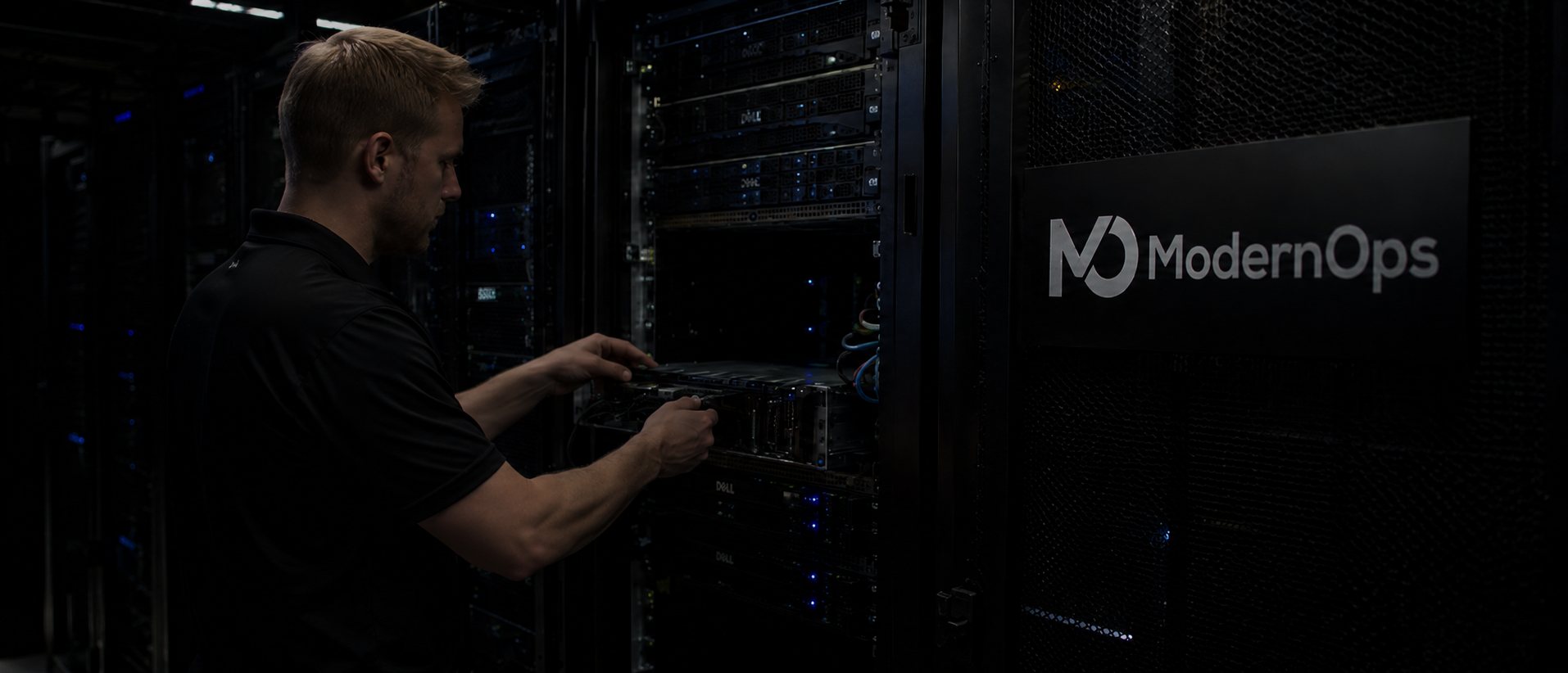
Wave-based workload moves with tooling like Coriolis, target cluster builds on shared storage, backup integration, cutover validation and documented rollback. One current program covers roughly 190 production VMs at a large public research university’s offsite data center. ModernOps’ own hosted platform runs on a multi-node Dell Proxmox VE cluster with shared all-NVMe Ceph storage, redundant cluster interconnects and replicated storage, so the engineers scoping your migration operate this stack daily.
All-flash node refreshes and license renewals for teams standardized on HCI simplicity, quoted and deployed as a repeat practice.
Measured-utilization consolidation designs, like collapsing 64 VMs from six aging hosts onto four newer ones in a three-active plus N+1 pattern, paired with fixing the opposite problem at branch sites: replacing single-host locations with two-node HA so a failed server at a branch becomes a ticket rather than a site outage.
UCS firmware and hypervisor versions upgraded as one coordinated change: interoperability validation, pre-change configuration backups, maintenance-mode host evacuation, sequential remediation and full-stack validation of networking, datastores, HA and DRS.
Steady-state workloads on owned infrastructure, elastic and exploratory demand in Azure or AWS, with orchestration tooling like Rafay and Azure Arc keeping governance in one place, architected and quoted as one operating model. GPU and HPC designs live on the AI & Accelerated Compute page.

PowerEdge R-series specified, procured and deployed as the standard mid-market virtualization host: current-generation trios and quads paired with shared storage and collapsed-core networking. Refresh cycles, OEM or third-party support strategies, and the same hardware family ModernOps runs its own production Proxmox VE platform on.
ProLiant consolidation targets designed from measured utilization, including reuse of healthy existing HPE hosts as DR capacity instead of writing them off. We specify, procure and design around ProLiant; Aruba networking depth lives on the Data Center Networking page.

Blade and rack UCS estates carried through firmware lifecycles in lockstep with the hypervisor, plus refurbished-node capacity adds where the economics beat new. The work is service-heavy, which is why few resellers offer it and why we kept it.

VVF and VCF subscription structuring, multi-year billing, renewals at scale, and in-place vSphere upgrade services. Staying on VMware is the right answer for some estates, and we model the exit anyway so the renewal is negotiated with a priced alternative on the table. The long-form argument: Field Note 01, The 3-Host VMware Trap, and the Tech Talk, The VMware Exit Strategy.

All-flash refreshes, license renewals and HCI designs for teams that want the cluster to be the product.

Licensing, subscriptions, wave-based migrations and cluster builds on Proxmox VE with Ceph. ModernOps runs its own hosted platform on Proxmox VE, so the team quoting your migration operates this stack every day and has already made its early mistakes on our own cluster.

The natural landing zone for Microsoft-standardized shops, tied to the CSP and Software Assurance licensing practice.
Azure and AWS compute for elastic, short-lived or unpredictable demand, with Azure Arc and Rafay-class orchestration for single-pane governance. The documented rule: cloud for burst, owned infrastructure for sustained utilization where the long-term unit cost wins.
Scale Computing, Red Hat, Stratus, Omnissa.
| Dimension | The old model | ModernOps |
|---|---|---|
| Architecture | Refresh the incumbent stack, vendor by vendor | Assess workloads, then design physical, virtual, HCI, cloud or accelerated as one system |
| Capacity | Sized from old purchase counts and peak anecdotes | Sized from measured CPU, memory, growth and failure-domain analysis, with defined headroom |
| Vendor choice | Follows incumbency or the reseller’s quota | Dell, HPE, Cisco, VMware, Nutanix, Proxmox VE, Hyper-V, Azure and AWS selected on fit |
| Change risk | Firmware, hypervisor and backup upgraded as separate projects | One runbook, one rollback plan, one validation pass across the stack |
| Migration | Manual moves and undocumented dependencies | Assessed waves, replication, controlled cutover, owner validation, documented rollback |
| Lifecycle | Reseller ships boxes, your team inherits the integration | One line of accountability from architecture through optional 24/7 operations |
| Phase | What happens | What you hold at the end |
|---|---|---|
| Assess and decide · Days 0 to 10 | Inventory hosts, VMs, hypervisors, dependencies, backup coverage, lifecycle, utilization and licensing. Identify consolidation, refresh, migration and hybrid options. | A current-state baseline, risk findings, capacity analysis and a shortlist of viable target architectures. The quote comes after the design. |
| Design and implement · Days 10 to 24 | Finalize the reference architecture, validate compatibility, register and source the bill of materials, build or upgrade hosts and clusters, prepare migration and rollback runbooks. | A tested path to production with visible checkpoints and documented dependencies. |
| Validate and optimize · Days 24 to 30 | Validate cluster health, HA and failover, networking, datastores, backup coverage and monitoring. Deliver as-built documentation and the next-wave roadmap. | An operable platform baseline and a prioritized plan, with the option to continue into migration waves or managed operations. |
The foundation lands in the first month. Large migrations then run in planned waves on their own timeline; a 190-VM cutover is a multi-month program.
We price both, side by side, because we sell the hardware and we run the hosted platform. This page covers the architect, source, deploy and migrate work. Ongoing operations, monitoring, patching and lifecycle live in Server Management, whether we sold the environment or inherited it.
One assessment modeled a drop from roughly 864 to 576 VMware cores while keeping CPU under 50 percent with N+1 intact.
A wave-based VMware to Proxmox VE program for a large public research university’s offsite data center, from cluster build through cutover validation.
ModernOps’ own platform: a multi-node Dell cluster on Proxmox VE with shared all-NVMe Ceph, redundant cluster interconnects and replicated storage.
Hosts, hypervisor, renewal state: whatever you have. We will model consolidation and platform options against it.